‏إظهار الرسائل ذات التسميات English posts. إظهار كافة الرسائل

السبت، 6 يونيو 2026

Inspire You


Inspire You

 A Journey into life inspiration, and human legacy 

In his book, Maan Fatani took me on a journey into his philosophical mindset. After reading the book I was inspired. I paused and thought and read until the end.  I felt his enthusiasm, his love and passion for learning and growing, for sharing and giving. I read his sweet and sour moments in his journey in the river of life. and I paused at the words of wisdom he planted on the pages of the book, and after digesting it all; here are some of the many memorable quotations from the book. 

1- " Don't wait for the sign be the sign". page 21

2- "The happiest of people don't necessarily  have the best of everything; they just make the most of everything that comes along their way. " page 22

3- " I promised myself never again live on autopilot. "page 32

4- " In simplicity beauty feels at home." page 36

5- "I ask the same question but with a different lens." page 38 

6-"We all have moments when life tests our limits. page 46 

7- " Success in not measured by what we keep, but by what we give."

8- " Because inspiration is like dopamine. It is not something we wait for. It is something we create, one meaningful moment at a time." page 82

9- "Create more than you consume. "

10- "Culture is the engine that powers everything." page 118

11- " We train the body by repetition. The mind is the same." page 127

12. " The greatest battles are often internal." page 128

13- " Feed your soul everyday and everything else will rise with it." page 134

14- " Life also teaches us through timing. Not everything arrives when we expect it, and often the waiting itself is the lesson........." 147 

15-" Patience builds emotional trust, and deepens the trust in the process, and allows blessings to meet us when we are truly ready." 147

16- " Every person you meet is carrying a lesson." 149

17- "Sometimes the most powerful lessons come through play." 153

17- " I learned that presence often matters more than immediate solutions. Many situations do not need quick answers; they need genuine listening......" 163

الأربعاء، 25 مايو 2022

Keep it simple, keep it basic.


New place , continue the journey 

books

visual walls

workshop tools

educational games and resources 

Samples of students work and portfolios

handouts and classroom supplies

snacks, coffee ,tea , and water

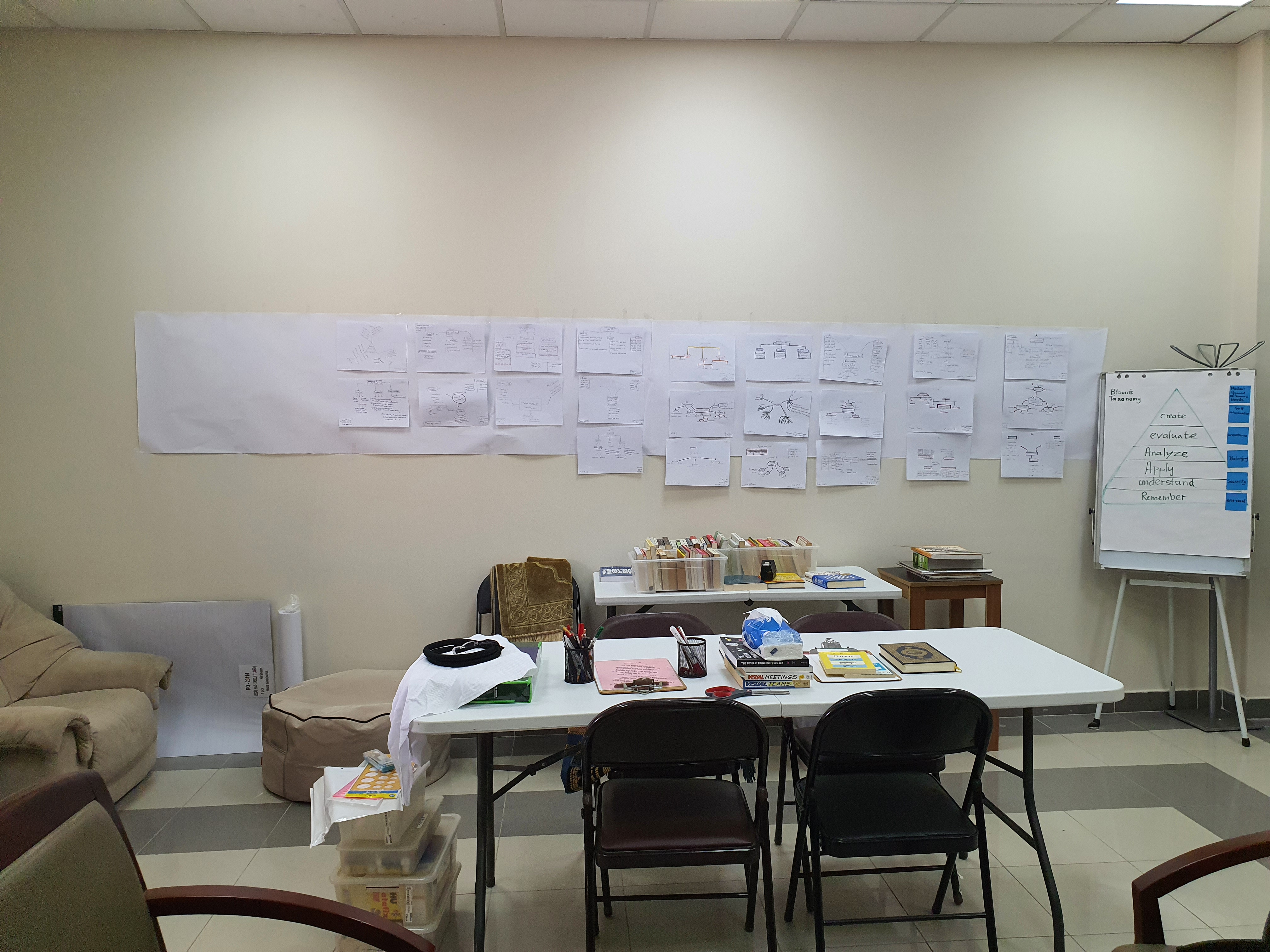
     The curriculum kitchen is back in another location. The place is still on organize phase, but we will built it as we go. We are still moving things ,and we are preparing for new ideas. A place where we think , act, and reflect on our teaching and on students learning.

     We are also working on an anther space in our general department building . We plan to create a multifunctional space ,with the help of our new department head Mr. Tariq Alzahrani and teachers in the department. A resource room for our general department and a space for workshops and training. We don't have a big budget so we will keep it simple and practical. We need to empty the room of the old office furniture, and start from scratch. Nothing fancy, keep it simple, and keep it basic. 


الأحد، 20 أكتوبر 2019

Fundamental Educational Principles in The English Language program


Fundamental Educational Principles


Focus is on learning rather than teaching


1- Teachers help students discover how language works and develop inner criteria for correctness.
2- Teacher “talk” is kept to minimum.
3- Independent study is targeted towards individual needs.
4- Students learn through ‘doing ‘(experiential learning).
5- Success is measured by what students can “do" communicatively rather than by what they can do cognitively.
6- A teacher covering specified materials (textbooks or otherwise) does not constitute learning.
7- Learning /skill development requires practice and awareness outside as well as inside the classroom.


Students are best served through humanistic, holistic, approaches


1- A caring relationship between student and teacher is established by treating student as a “whole” person.
2- Language is most effectively learned as a “whole” system and not a collection of isolated skills.
3- Linguistic and thinking skills are inter-related and inter-dependent.
4- Lessons integrate linguistic and professional skills and objectives.
5- Lessons should be structured as much as possible to draw on student knowledge, experience, ideas, and interests.
6- Teachers help students develop ways to facilitate their own learning and to improve weaker skills.

الخميس، 14 يناير 2016

English for Hotel and Tourism : A short story The language of Hospitality


I arrived in front of the bank early. It was still closed, so I looked around for a place to sit. Near the bank there was a hotel. I looked, they had a big reception and a small coffee bar. I walked to the hotel and sat in the hotel lounge. There were few people around. My plan was to sit for a few minutes and order something to drink. 5 minutes went by and no one came from the coffee bar. I got up and walked to the receptionist and greeted him, he greeted me back. This how the conversation went..........

read more:
 English for Hotel and Tourism : A short story The language of Hospitality:

الخميس، 23 أبريل 2015

To fiction or not to fiction, that is the question?


         "Logic will get you from A to B,
 but imagination will get you anywhere" Einstein


I always preferred reading non fiction books, but I like reading fiction every now and then.
Fiction is an interesting aspect of language. There are many doctors and engineers who love to read novels for different reasons.

When we were students in college, there was a power struggle between linguistic teachers and literature teachers. They all just got their PHD degrees from abroad, each one thought the other party was bad news.

We really did not have beef with any of them, we liked them both.

The teachers had the ability to make us like something or hate it. Add to that, we had no voice in most cases. Our only role then was to declare on which team we were playing. So we played by the rules.

If you ask me, who was right and who was wrong. I will tell you both were right; too much of anything was an over kill.

السبت، 4 أكتوبر 2014

Designing a Course with my students? (Part One)


     Few years ago, I taught a course on Medical Terminology , for medical secretary students at King abdul azizi university, in Jeddah.  It was a big challenge for me. I only had a few days notice. The first thing I did was,  I went to the bookstore and bought five books on the subject. Then, went home and started reading and mind-mapping the plan for teaching this course.

 
 some of the books I bought


      I knew the students from last term, I taught them general English. But this time, I was to teach them Medical terms. I felt that we both were learning something new. After laying down the plan for the course, I discussed it with them.

      In the discussion, I asked them a number of questions to get better feedback and to engage them in the planning  and tailoring of curriculum, so that they take responsibility for their learning. I was given full freedom by my supervisor to choose, and decide what to teach.

Some of the questions were:
1- What were their expectations?
2- What they expected to learn  by the end of this course?
3- What are the topics that we needed to address in the course ?
4- How many medical terms they can cover per week?
5- Why this course was important in their study?

      From day one, I felt students were fully engaged in the process of tailoring of the course.  There were nineteen students in the course. I took notes of all the students suggestions. First class was a workshop approach to help me and the students make smart objectives for the course.

       When I went home, I sat down and did the necessary adjustments based on students needs, and what they lack, and the skills they needed to succeed in the course. The second class, was the results of our workshop.

      I felt we needed to add another approach to make this course fruitful and meaningful. That approach was the project-based learning method. I will discuss this approach in part two.


Topics covered in the course:

1- How to read a medical term?
2- Basic Word structure
3- Suffixes
4- Prefixes
5- Medical Specialists\ hospital wards 
6- Body systems
7- Major Classes of drugs
8- Common diseases 
9- Common medical surgeries
10- Abbreviations and symbols
11- Diseases Terminology related to the body